
Off-Axis Absolute Rotary Magnetic Encoders
Hollow-shaft position feedback for compact motion systems
The OTV-OMEC is a thin-profile, hollow-shaft absolute rotary magnetic encoder for compact motion systems. Its non-contact, off-axis readhead leaves the center bore open for a shaft, cables, or services while delivering single-turn absolute position feedback. With an IP67-rated system, it is designed for rotary applications that need a compact mechanical package and position data immediately available at power-up.
Compare OTV-OMEC models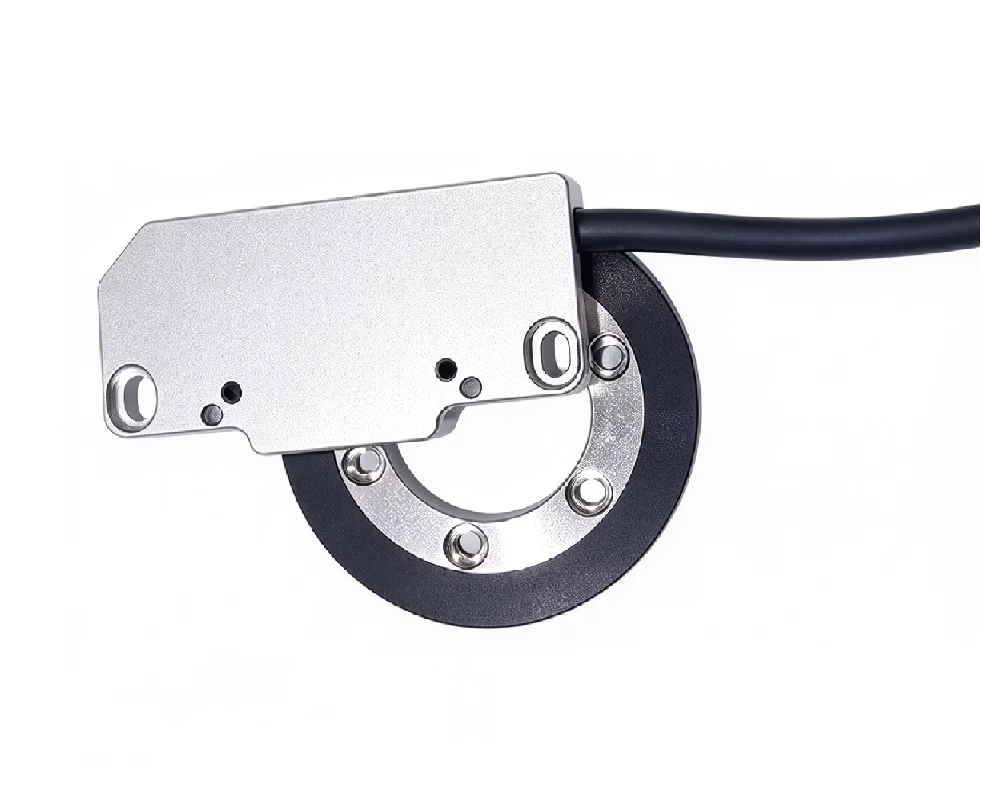
Absolute feedback in an off-axis layout
This hollow-shaft absolute rotary encoder uses a magnetic ring that rotates with the shaft and a stationary readhead positioned off the shaft centerline. The non-contact arrangement keeps the center bore clear and provides absolute angular position without relying on incremental counts after power-up.
Axially magnetized ring
The magnetic target uses an axial magnetization pattern. Ring geometry, sensor orientation, and air gap must follow the selected encoder configuration.
Single-turn absolute position
Absolute position is available after power-up without requiring the system to establish position by incremental counting. Resolution options span 16 to 20 bits per revolution.
Interfaces for motion control
Available interface options include BiSS-C, SSI, SPI, and Tamagawa formats, depending on the selected configuration. Confirm protocol, electrical level, and timing with the controller.
OTV-OMEC hollow-shaft absolute rotary encoder selection
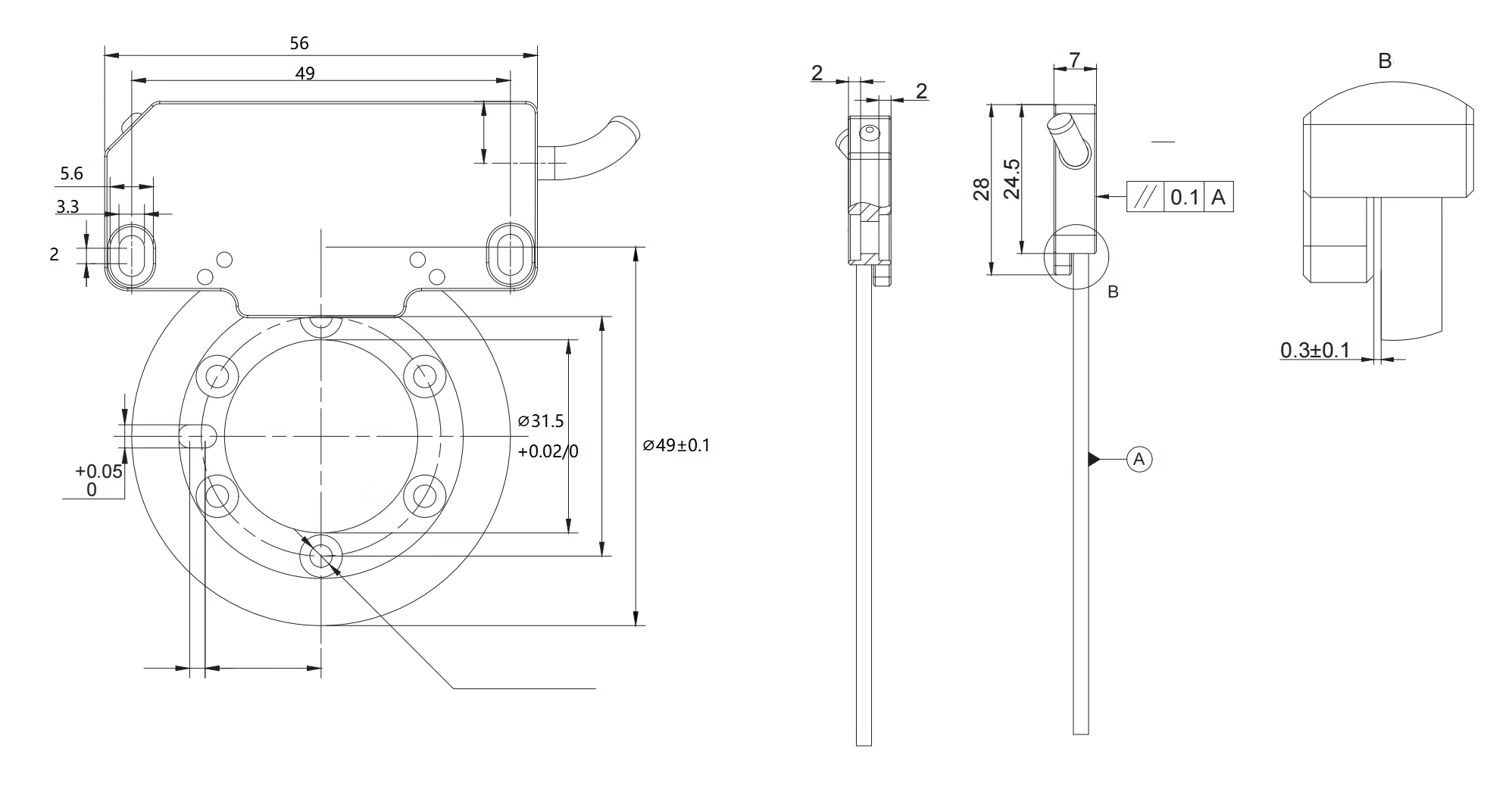
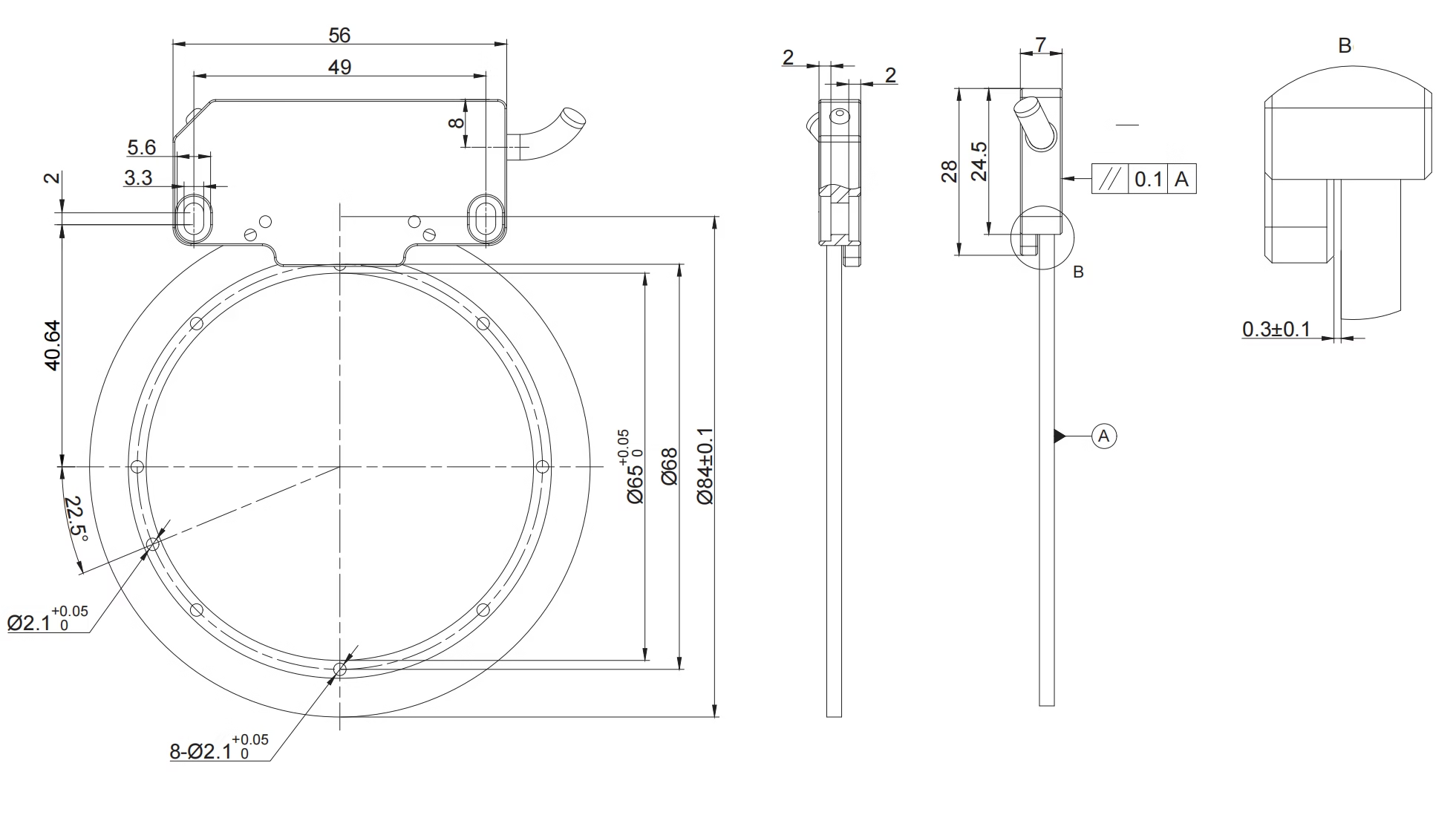
Choose an OTV-OMEC configuration by inner diameter (bore), then compare the matching ring outside diameter, resolution, maximum speed, mounting holes, and thickness. The integrated magnetic rotary encoder is designed for hollow-shaft absolute position feedback in a thin, IP67-rated package.
| OTV model (by ID) | Ring OD | Resolution | Maximum speed | ID / bore | Mounting holes | Thickness |
|---|---|---|---|---|---|---|
| OTV-OMEC-ID25 | 49 mm | 16–20 bit | Up to 9,500 rpm* | 25 mm | 4 | 2.0 mm |
| OTV-OMEC-ID25 | 49 mm | 16–20 bit | Up to 9,500 rpm* | 25 mm | 6 | 3.9 mm |
| OTV-OMEC-ID31.5 | 49 mm | 16–20 bit | Up to 9,500 rpm* | 31.5 mm | 0 | 2.0 mm |
| OTV-OMEC-ID62 | 84 mm | 16–20 bit | Up to 4,700 rpm* | 62 mm | 0 | 1.8 mm |
| OTV-OMEC-ID65 | 84 mm | 16–20 bit | Up to 4,700 rpm* | 65 mm | 8 | 2.5 mm |
* Maximum speed depends on ring size and operating conditions. Confirm the allowable speed for the final encoder assembly.
Electrical and environmental specifications
| Parameter | Specification | Selection / integration note |
|---|---|---|
| Supply voltage | 5 V ±5% | Verify supply tolerance and noise at the readhead. |
| No-load current | <85 mA at 25 °C | Use the final configuration for power budgeting. |
| Absolute position startup | <100 ms | System timing depends on power-up and interface configuration. |
| System accuracy | ±0.1° within specified mounting tolerances | Validate the complete mechanical stack and calibration conditions. |
| Operating temperature | −30 °C to +85 °C | Confirm the temperature range for the assembled system. |
| Humidity / ingress protection | 0–100% RH (condensation permitted in source specification); IP67 | Confirm sealing details and connector installation for the application. |
| External magnetic field | ±0.5 mT during operation | Assess nearby motors, brakes, and magnetic components. |
| Output load current | ±40 mA for RS422 / RS485 outputs | Protocol and output stage vary with selected interface. |
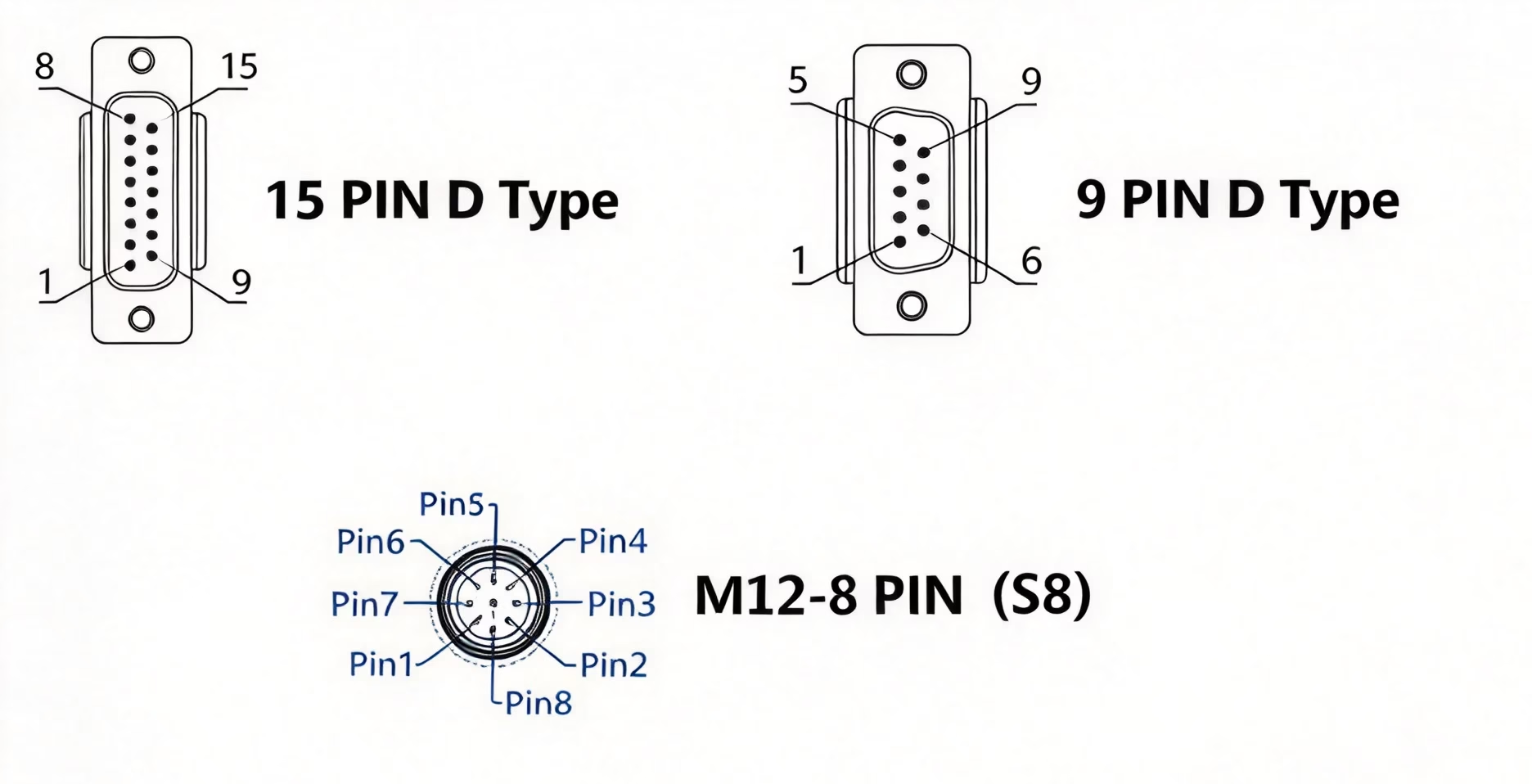
| Connectors | DB9, DB15, or 8-pin M12; bare-wire option | Pin assignment can be configured; confirm before harness release. |
| Cable | 8-core TPU, double-shielded twisted construction; 4.4 mm OD ±0.15 mm | Standard length 0.5 m; other lengths can be discussed. |
| Cable flex life | 20 million cycles at 35 mm bend radius (published test condition) | Dynamic bend radius 25 mm; static bend radius 10 mm. |
Supported communication options
BiSS-C / RS422
Maximum clock frequency: 5 MHz in the published configuration.
SPI / TTL
Maximum clock frequency: 10 MHz in the published configuration.
SSI / RS485 and Tamagawa
Published configurations list up to 100 kbaud for SSI / RS485 and 2.5 Mbaud for Tamagawa / RS485. Confirm the selected protocol and frame format.
Connector and cable options
Connector selection depends on the chosen interface and installation. Available configurations include DB9, DB15, 8-pin M12, or a bare-wire cable end. The standard cable is an 8-core, double-shielded twisted TPU cable with a 4.4 ±0.15 mm outer diameter; standard length is 0.5 m, with other lengths available for discussion.
Confirm connector orientation, pin assignment, cable length, bend radius, and controller wiring before releasing the harness design.
Specifications are configuration-dependent and should be confirmed against the final OTV Sensing datasheet and installation requirements before design release.
Where OTV-OMEC encoders fit
Robot joints and cobots
Off-axis sensing preserves a central passage for cables and services in compact rotary joints.
Rotary tables and stages
Absolute angular feedback supports indexing and position monitoring where the shaft center must remain open.
Servo motors and actuators
Choose the interface and ring geometry around the drive, speed range, and mechanical tolerance stack.
How to select an OTV-OMEC configuration
Frequently asked questions
Does the encoder require homing after power-up?
The system provides single-turn absolute position feedback, so position does not need to be established by incremental counting after every power cycle. Confirm the startup sequence with the selected controller interface.
Can OTV-OMEC use a different ring diameter or bore?
The listed bore options are 25, 31.5, 62, and 65 mm, paired with 49 mm or 84 mm ring outside diameters. If another bore or mechanical envelope is needed, contact OTV Sensing to discuss a custom configuration.
Is ±0.1° the accuracy of the ring by itself?
No. The stated system accuracy applies within specified installation tolerances. Ring magnetization, runout, centering, readhead alignment, air gap, and calibration affect the assembled encoder performance.
Which connector and protocol should I choose?
Choose the interface supported by your motion controller and confirm its electrical layer, timing, pinout, cable length, and noise environment. Available options depend on the configuration.
Explore related OTV Sensing encoder technologies
Compare other magnetic and rotary position feedback options for your mechanical layout and application.
Discuss your rotary encoder requirements
Share your shaft and bore dimensions, mounting space, required protocol, speed, accuracy target, and operating environment. OTV Sensing can review standard and custom OTV-OMEC configurations with you.
Contact OTV Sensing