
High-Precision Absolute Inductive Encoders for Demanding Motion Control
- Non-contact · Bearingless · Hollow-shaft design
- ±0.006° accuracy · 15-22 bit resolution
- 13 standard models · No maintenance
What Is an Inductive Encoder?
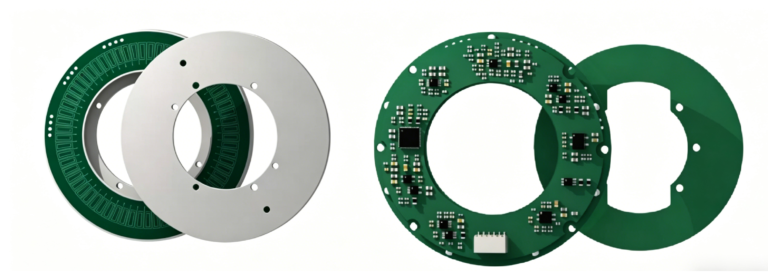
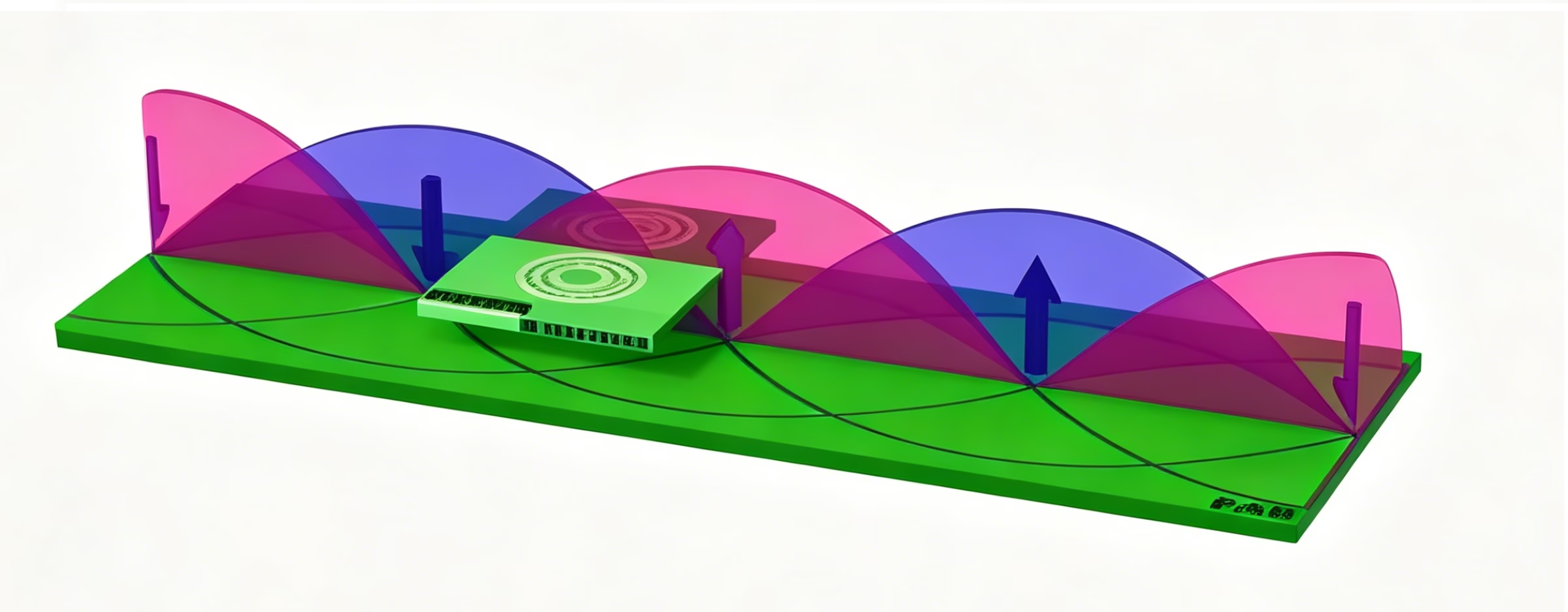
An inductive encoder uses electromagnetic induction and wireless energy transfer to measure absolute angular position — without optical discs, glass gratings, or permanent magnets. The stator wirelessly powers the rotor, which returns a position signal through electromagnetic field modulation.
Unlike optical encoders that fail in dust, oil, or vibration, inductive encoders deliver maintenance-free absolute positioning even in the harshest conditions.
- 1Wireless Power TransferStator coil energizes → power transmitted to rotor via electromagnetic coupling
- 2Dual-Track Position SensingRotor modulates the magnetic field → stator reads absolute angle via dual code tracks
- 3Digital OutputOnboard ASIC converts to SSi / BiSS-C / RS-422 / RS-485 / ABZ in real-time
Inductive vs Optical vs Magnetic Encoders
| Feature | Inductive (OTV-INE) | Optical Encoder | Magnetic Encoder |
|---|---|---|---|
| Resistance to Dust / Oil |  Immune Immune | ✘ Sensitive to contamination | Resistant |
| Vibration / Shock Tolerance | Excellent | ✘ Glass disc fragile | Good |
| Accuracy | ±0.006° ~ ±0.05° | ±0.001° ~ ±0.01° | ±0.05° ~ ±0.5° |
| Profile (Thickness) | 3.6 mm ultra-thin | 15 ~ 30 mm | 8 ~ 15 mm |
| Hollow Shaft (Large Bore) | Up to Ø172mm | ✘ Limited / no | Moderate |
| Bearing / Coupling Required? | None needed | ✘ Requires bearings | — Some models |
| Maintenance | Zero (non-contact) | Periodic cleaning | Low |
| Cost at Scale | Competitive | High (precision optics) | Low |
| Operating Temperature | -30 ~ +100°C | -10 ~ +70°C | -20 ~ +85°C |
OTV-INE Series — Precision
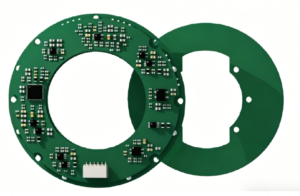
Ultra-thin profile (3.6–8 mm), highest resolution (up to 22-bit), best accuracy (up to ±0.006°), highest speed (up to 8,000 rpm). IP40. Ideal for space-constrained precision motion control — robotics, aerospace, gimbals, and medical devices.
OTV-INEC Series — Rugged
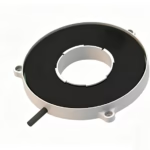
IP67-rated for harsh environments, wider operating temperature (-40°C to +85°C), wider supply voltage (5–30 V). Aluminum alloy housing. Ideal for industrial automation, servo motors, and demanding environmental conditions.
OTV-INE Series — 13 Standard Models
All models: Non-contact · Hollow-shaft · FR-4 material · Single-turn absolute · 5-24V DC · IP40
| Model | OD × ID × T (mm) | Weight | Resolution | Accuracy | Max Speed | Rotor Inertia |
|---|---|---|---|---|---|---|
| INE-014 | 14.8 × 2 × 3.6 | 2 g | 15-17 bit | ±0.03° | 6000 rpm | 0.006 kg-mm² |
| INE-016 | 16.8 × 2 × 3.6 | 2.5 g | 15-17 bit | ±0.025° | 6000 rpm | 0.008 kg-mm² |
| INE-018 | 18.8 × 2 × 3.6 | 3 g | 15-17 bit | ±0.02° | 6000 rpm | 0.01 kg-mm² |
| INE-020 | 20 × 4 × 6.5 | 4 g | 15-17 bit | ±0.05° | 4000 rpm | 0.01 kg-mm² |
| INE-040 | 40 × 10 × 7.8 | 10 g | 17-18 bit | ±0.015° | 6000 rpm | 0.4 kg-mm² |
| INE-052 | 52 × 17.7 × 7.6 | 13 g | 18-20 bit | ±0.01° | 8000 rpm | 1.18 kg-mm² |
| INE-060 | 60 × 25 × 7.6 | 18 g | 18-20 bit | ±0.008° | 8000 rpm | 2.43 kg-mm² |
| INE-080 | 80 × 35 × 8 | 30 g | 18-20 bit | ±0.008° | 8000 rpm | 8.6 kg-mm² |
| INE-100 | 100 × 48 × 8 | 40 g | 19-21 bit | ±0.006° | 6000 rpm | 19.7 kg-mm² |
| INE-120 | 120 × 70 × 8 | 50 g | 19-21 bit | ±0.006° | 6000 rpm | 40 kg-mm² |
| INE-140 | 140 × 90 × 8 | 75 g | 19-21 bit | ±0.006° | 6000 rpm | 99 kg-mm² |
| INE-180 | 180 × 120 × 8 | 120 g | 20-22 bit | ±0.006° | 4000 rpm | 239.2 kg-mm² |
| INE-247 | 247 × 172 × 8 | 180 g | 20-22 bit | ±0.006° | 4000 rpm | 795.6 kg-mm² |
 Download Full Product Datasheet (PDF)
Includes mechanical drawings, electrical specs, ordering codes, and installation guide for all 13 models.
OTV-INEC Series — 9 Standard Models
All models: Non-contact · Hollow-shaft · Aluminum alloy + FR-4 · Single-turn absolute · 5-30V DC · IP67
| Model | OD × ID × T (mm) | Weight | Resolution | Accuracy | Max Speed | Rotor Inertia |
|---|---|---|---|---|---|---|
| INEC-016 | 16 × 4 × 9 | 5 g | 15-17 bit | ±0.05° | 4000 rpm | 0.005 kg-mm² |
| INEC-025 | 25 × 6 × 7 | 10 g | 15-17 bit | ±0.025° | 4000 rpm | 0.042 kg-mm² |
| INEC-025P | 25 × 6 × 7 | 10 g | 15-17 bit | ±0.025° | 4000 rpm | 0.042 kg-mm² |
| INEC-037 | 37 × 10 × 8 | 15 g | 16-18 bit | ±0.02° | 4000 rpm | 0.197 kg-mm² |
| INEC-040 | 40 × 10 × 10 | 25 g | 16-18 bit | ±0.02° | 4000 rpm | 0.197 kg-mm² |
| INEC-058 | 58 × 20 × 10 | 40 g | 17-19 bit | ±0.015° | 4000 rpm | 0.684 kg-mm² |
| INEC-070 | 70 × 30 × 10 | 55 g | 17-19 bit | ±0.015° | 3000 rpm | 3.338 kg-mm² |
| INEC-130 | 130 × 90 × 10 | 200 g | 18-20 bit | ±0.01° | 1500 rpm | — |
| INEC-170 | 170 × 120 × 11.5 | 260 g | 18-20 bit | ±0.01° | 1500 rpm | 219.237 kg-mm² |
Technical Advantages
Why Engineers Choose OTV Inductive Encoders

Bearingless & Coupling-Free
No internal bearings, no mechanical couplings. The rotor mounts directly on the shaft. The stator fixes to the housing. Installation gap: 0.6mm ±0.1mm. Zero friction, zero wear.

5-in-1 Protocol Support
SSi (0.5-5MHz) · BiSS-C (up to 10MHz with CRC) · RS-422 full-duplex · RS-485 half-duplex · Differential ABZ with Z-phase. One encoder, any controller.

Extreme Environment Ready
Operates from -30 to +100°C. Resistant to shock (100g/11ms), vibration (20g 10-2000Hz), electromagnetic interference, and 0-99% humidity. No degradation in oil mist or dust.

Ultra-Thin Profile
As thin as 4mm — the slimmest absolute encoder in its class. Fits space-constrained robot joints, gimbals, and actuator housings where conventional encoders simply won’t fit.

Class-Leading Accuracy
Up to ±0.006° static error with 22-bit resolution. Repeatability: ±2 LSB. Exceeds magnetic encoders in precision while matching optical at a fraction of the size.

Power-On Absolute Position
True single-turn absolute output — knows its angle the instant power is applied. No homing routine, no backup battery, no reference mark search. Simplifies system startup.
Where OTV Inductive Encoders Excel

Collaborative Robots
Ultra-thin hollow-shaft design for joint torque sensors and motor feedback. Withstands cobot collision forces without recalibration.
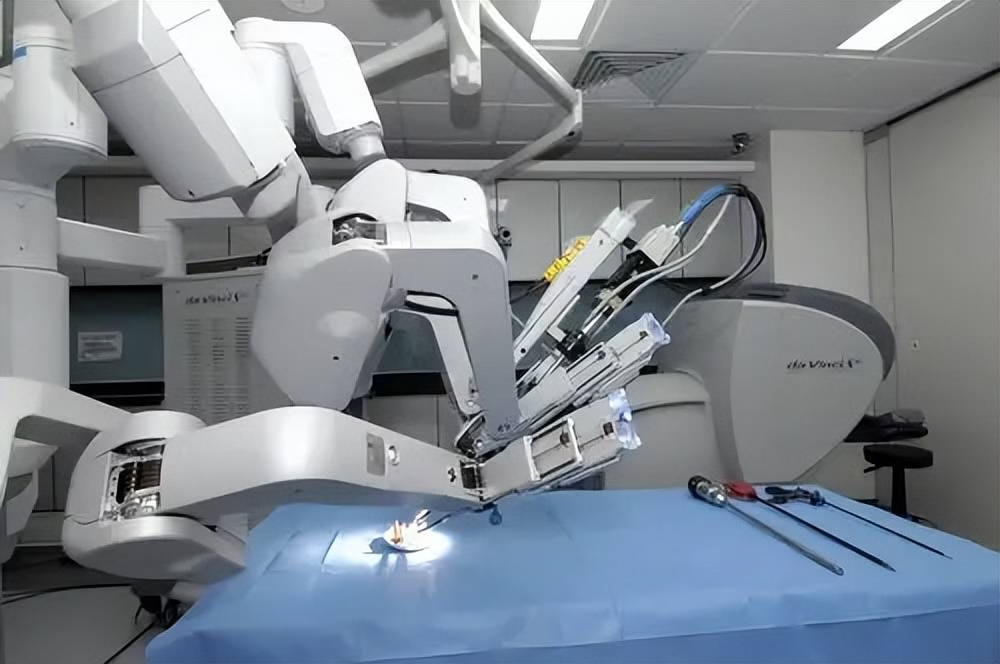
Surgical & Medical Robots
Non-contact, sterilizable-compatible, zero particulate generation. 20-bit resolution for sub-millimeter tool positioning.

Aerospace & Defense
Radar pedestals, satellite antenna gimbals, EO/IR turrets. Operates in vacuum, radiation, extreme temperature swings.
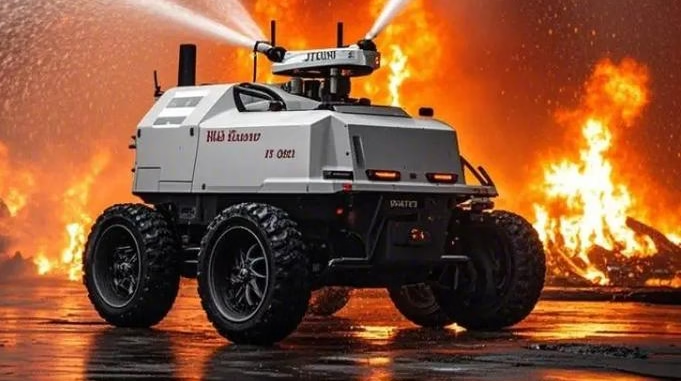
AGV & Mobile Robots
Steering angle feedback for automated guided vehicles. Immune to magnetic field interference from drive motors.

Industrial Automation
Servo motor feedback, rotary tables, packaging machinery. Drop-in replacement for optical encoders in dirty environments.
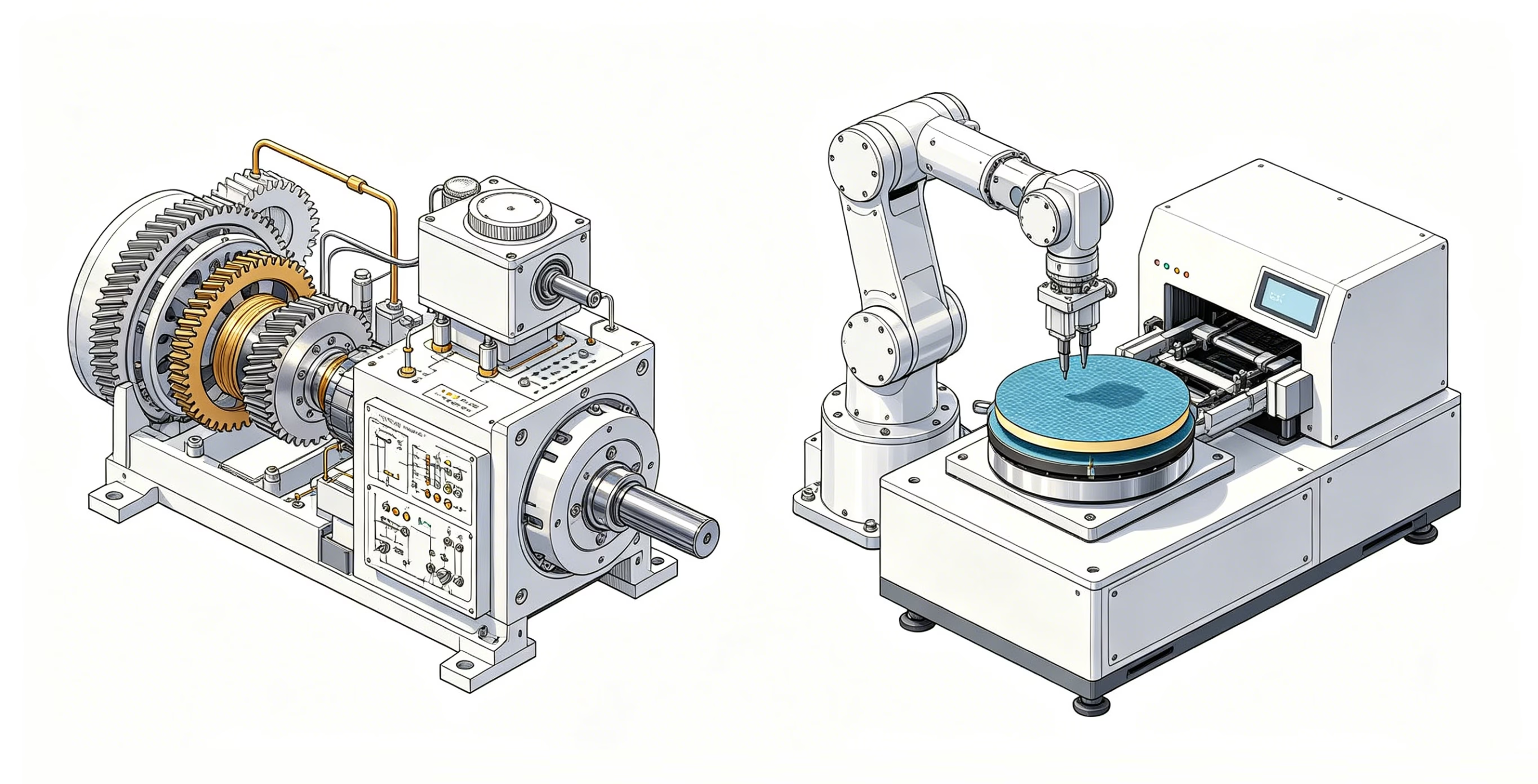
Semiconductor & Optoelectronics
Wafer handling robots, pick-and-place, optical alignment stages. Particle-free, vacuum-compatible, sub-micron repeatability.
Complete Your Motion Sensing Solution
Beyond inductive encoders, OTV also manufactures high-precision magnetic encoders and encoder magnetic rings — a full portfolio for your sensing needs.
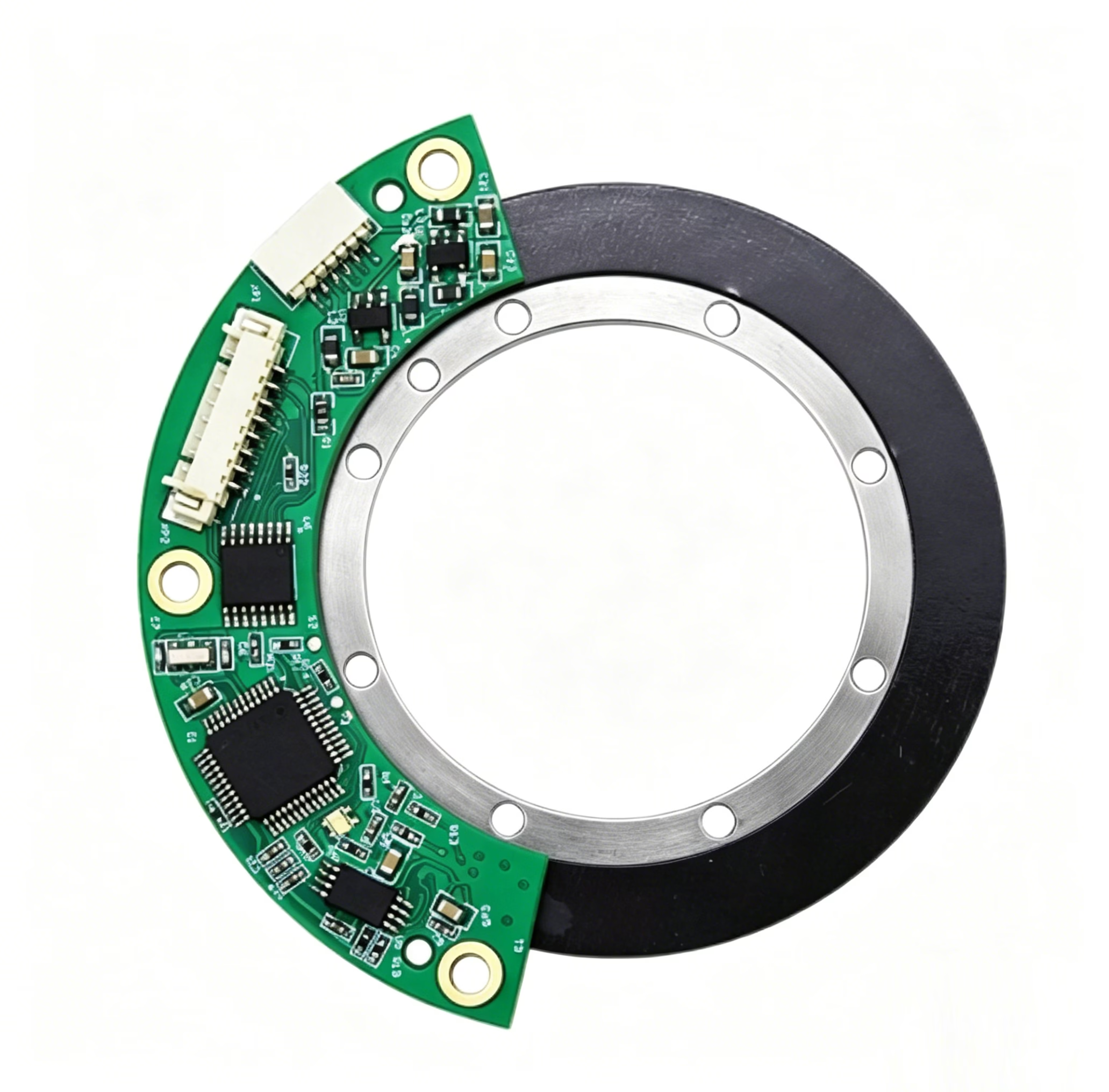
OME Series
Single-turn absolute magnetic encoder with 17-20 bit resolution, ±0.1° accuracy, 28.5mm ultra-compact form factor. SSi, BiSS-C, UART, SPI, ABZ protocols supported.
- 17-20 bit
- ±0.1° accuracy
- 8mm thin
- SSi / BiSS-C
- 6000 rpm
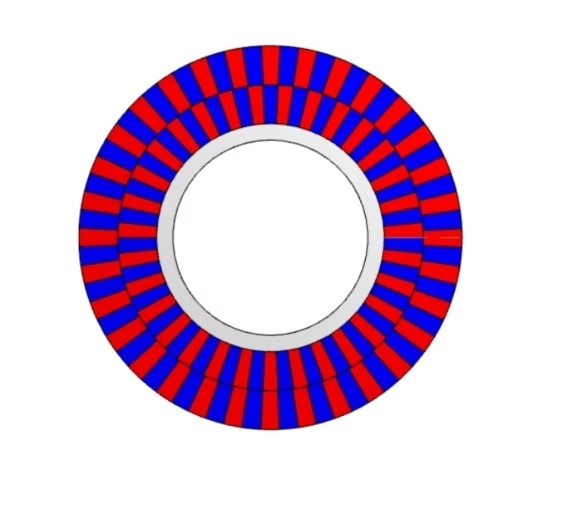
Precision Magnetic Rings
Single-track and dual-track magnetic encoder rings for use with magnetic encoders. Custom OD/ID/thickness, multi-pole magnetization, FR-4 substrate. Designed for OME series and third-party magnetic sensors.
- Single & Dual Track
- Custom Design
- Rubber+Metal
- Multi-Pole
- Low Inertia
- OEM Available
Common Questions About Inductive Encoders
Need a Custom Sensing Solution?
Every application is unique. OTV Precision Sensing delivers more than standard products — we engineer tailored encoder solutions and provide one-stop procurement to simplify your supply chain.

Custom Encoder Development
Need a specific OD/ID, resolution, protocol, or form factor? Our engineering team modifies standard designs or builds from scratch to your exact specifications.

One-Stop Procurement
Beyond encoders: magnetic rings, cables, connectors, mounting hardware, and accessories. We consolidate your BOM into a single order with one invoice and one shipment.

Dedicated Project Support
From concept to production. Feasibility review, rapid prototyping, NPI support, and ongoing quality management. Your assigned engineer stays with you throughout.
Tell us your requirements — we’ll respond with a solution within 24 hours.