
ENCODER IC COMPARISON
Novosense NSM3502 vs. iC-Haus iC-MU200
A practical comparison of performance, calibration, interfaces, pinout, and system integration for dual-track Nonius absolute magnetic encoder designs.
In robotics, servo motors, and industrial automation, dual-track Nonius (vernier) off‑axis hollow‑shaft absolute magnetic encoders have become the mainstream approach for high‑precision position feedback. The Novosense NSM3502 and the German iC‑Haus iC‑MU200 are two representative encoder ICs in this domain, both designed for dual‑track Nonius off‑axis/hollow‑shaft absolute magnetic encoder applications, with a master track pole width of 2.00 mm.
Although they share the same QFN48 7×7 mm package and a similar power‑pin layout, they differ significantly in architecture, integration, communication interfaces, and calibration capability.
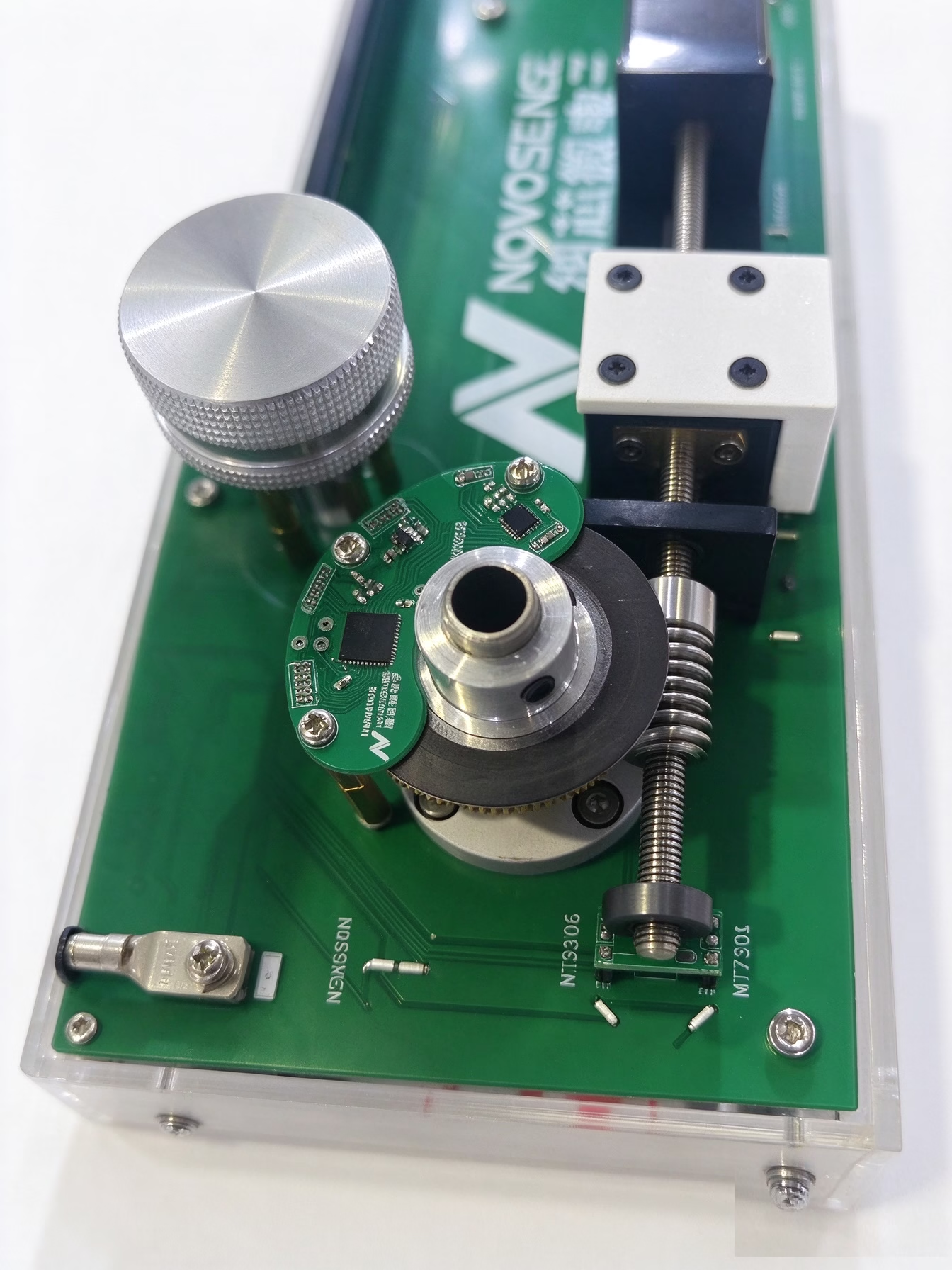
NOVOSENSE NSM3502
Explore the chip, compatible magnetic targets, and system-level evaluation in our NSM3502 encoder evaluation board guide.
Explore the NSM3502 evaluation board →Performance Comparison
| Parameter | Novosense NSM3502 | iC‑Haus iC‑MU200 |
|---|---|---|
| Single‑chip absolute resolution | Up to 22 bits | 18 – 20 bits (depends on pole‑pair count: 16/32/64) |
| Two‑chip cascade expansion | Not supported (intended for single‑turn/linear absolute applications) | Supported – can build a three‑track multi‑turn system with 24‑bit resolution |
| EEPROM integration | Integrated 3.3V – 5V programmable EEPROM – no external storage needed | Requires external I²C EEPROM |
| Self‑calibration capability | Highly integrated and automatic: 1. Quick calibration (no uniform rotation required; INL down to ±0.3°) 2. Uniform‑speed calibration (self‑computed nonlinearity written to internal EEPROM; INL down to ±0.1°) | Semi‑automatic / external‑host‑dependent: Provides analog signal conditioning (gain, phase, offset), but nonlinearity parameters (SPO calibration curve) must be calculated via PC GUI or an external MCU, then written to the external EEPROM |
| Communication interfaces | SPI (Mode 1 only), UART (up to 4 Mbps), PWM (12‑bit) | SPI, BiSS C‑Mode, SSI/Extended SSI; no UART |
| Incremental output | ABZ (1 – 65536 PPR), UVW (1 – 64 programmable pole pairs) | ABZ (1 – 65536 CPR), UVW (1 – 16 programmable pole pairs) |
| Fault diagnostics and alarm | Dedicated FAULT pin for weak/strong magnetic field, overspeed, EEPROM checksum error, undervoltage, and overtemperature alarms | STATUS0 / STATUS1 registers, or programmable output pins for error/warning signals |
| Supply voltage and current | 3.3V – 5.0V (nominal 3.0V – 5.5V); typical current 50 mA | 4.5V – 5.5V (nominal 5V); typical power consumption 53 mA (VPA 13mA + VPD 40mA) |
Pinout & Integration
Both devices use QFN48 (7×7 mm) packages, but their pin allocation and I/O architecture follow completely different philosophies.
Common Ground – Power and Ground Pins
Both chips share an identical power and ground pin assignment, making PCB‑level compatibility straightforward:
| Function | Pin |
|---|---|
| Analog supply (AVDD / VPA) | Pin 5 |
| Analog ground (AGND / VNA) | Pin 6 |
| Digital ground (DGND / VND) | Pin 31 |
| Digital supply (DVDD / VPD) | Pin 32 |
Differences – Digital and I/O Architecture
NSM3502 (dedicated‑function pins): Each function (SPI, UART, ABZ, UVW, calibration enable) is assigned to a dedicated fixed pin.
iC‑MU200 (multifunction configurable ports): Uses two configurable port groups – Port A (PA0–PA3, pins 27–30) can be configured via the
MODEAregister as SPI, BiSS, or SSI; Port B (PB0–PB3, pins 7–10) can be configured via theMODEBregister as ABZ, UVW, step/direction, or analog signal outputs.
How to Choose
Both chips excel in different scenarios – the choice depends on your specific requirements:
If your priorities are “fast production ramp‑up, low BOM cost, and simplified factory calibration”:
The NSM3502 is the better choice. It integrates a programmable EEPROM and features a powerful uniform‑speed self‑calibration / Nonius‑trim algorithm – simply rotate the magnet after installation and the chip automatically compensates for INL and stores the parameters internally, eliminating the need for external calibration software. In addition, its native UART interface makes it easier to integrate with MCU‑based systems at lower cost.
If your application demands “high‑end industrial control, multi‑turn servo motors, or ultra‑long travel absolute position detection”:
The iC‑MU200 remains the industry standard. It supports the BiSS C protocol – the mainstream industrial servo bus – and, thanks to its proprietary multi‑turn cascade protocol with MTC/MTD pins, two iC‑MU200 devices can be cascaded to achieve 24‑bit system resolution – an ideal solution for large‑stroke linear magnetic positioning or high‑precision multi‑turn absolute feedback.
Encoder Support from OTV Sensing
Chip selection is only the first step. To convert chip performance into system‑level precision, you need carefully matched magnetic rings, proven test platforms, and experienced engineering support.
OTV Sensing delivers complete encoder solutions – from chip to system:
Encoder ICs: Full‑portfolio supply of Novosense and iC‑Haus devices, with flexible ordering options.
Precision magnetic targets: Standard and custom designs (pole‑pair count, ID/OD, thickness, magnetization pattern) optimized for each IC.
Evaluation kits: Ready‑to‑use hardware (sensor daughter board, motherboard, USB adapter) to accelerate prototyping and system validation.
Application support: From magnetic circuit simulation and ring matching to firmware integration and calibration.
Whether you are prototyping or ramping to production, OTV Sensing provides the components, the engineering support, and the hands‑on expertise to help your project succeed.