
electronica China 2026: Embodied AI Is Redrawing the Magnetic Sensor Map
July 1, 2026 · Shanghai New International Expo Centre · OTV Sensing on the ground
Walking the halls at electronica China this year, one thing was impossible to miss: embodied AI has arrived, and it runs on magnetic sensors. Automotive and industrial automation still had their booths, but the gravitational center of the show had unmistakably shifted. Every semiconductor booth worth stopping at had a robot joint spinning, a gripper flexing, or a quadrupel strutting across the floor.
The chain here is straightforward: embodied systems need motors — lots of them. Motors need precise position feedback. And the silicon at the heart of that feedback loop — magnetic position sensor ICs — is undergoing a simultaneous technology shift and market expansion that we haven’t seen before.
Global Tier-1s: TMR Is Eating Hall, and Inductive Is Carving a Niche
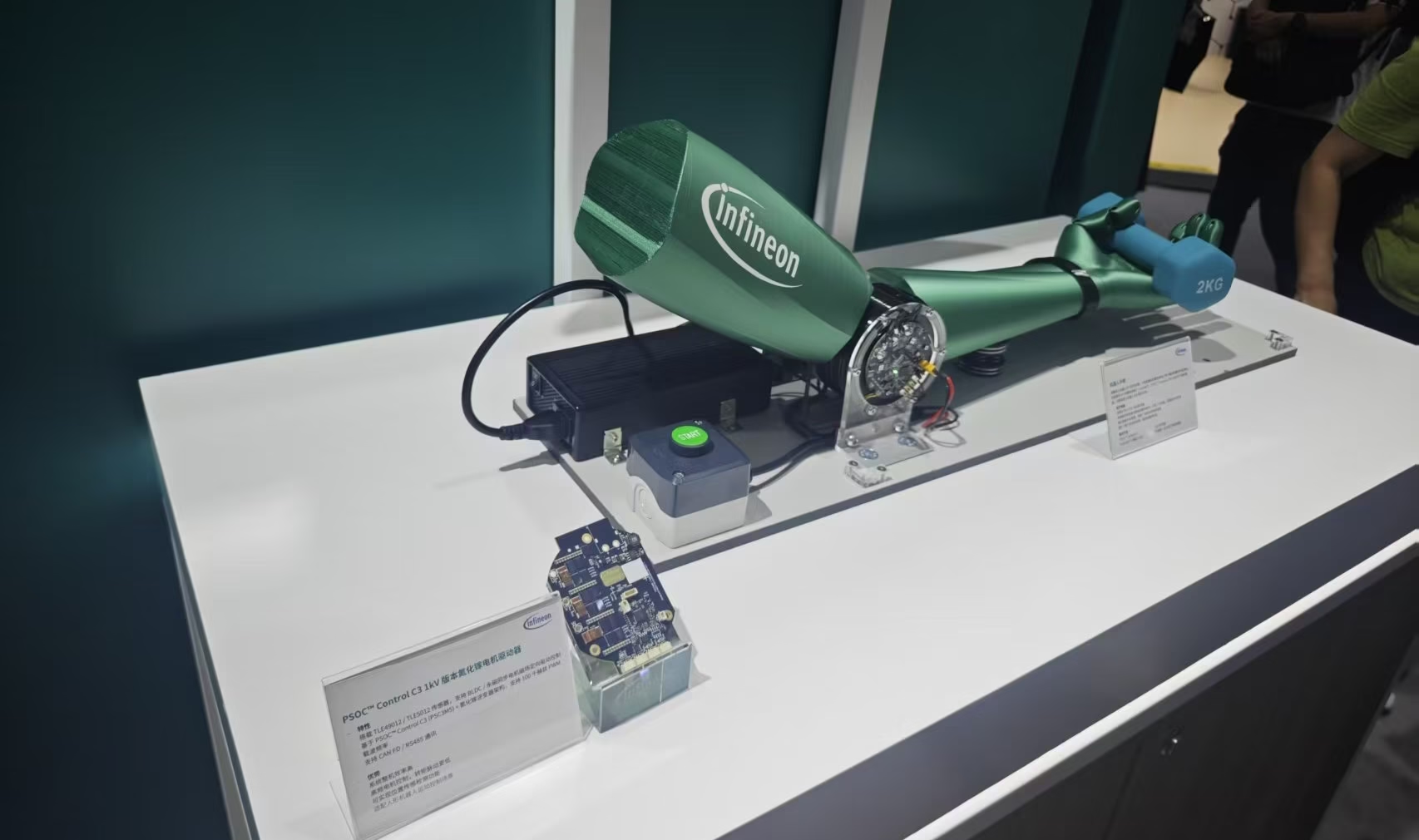
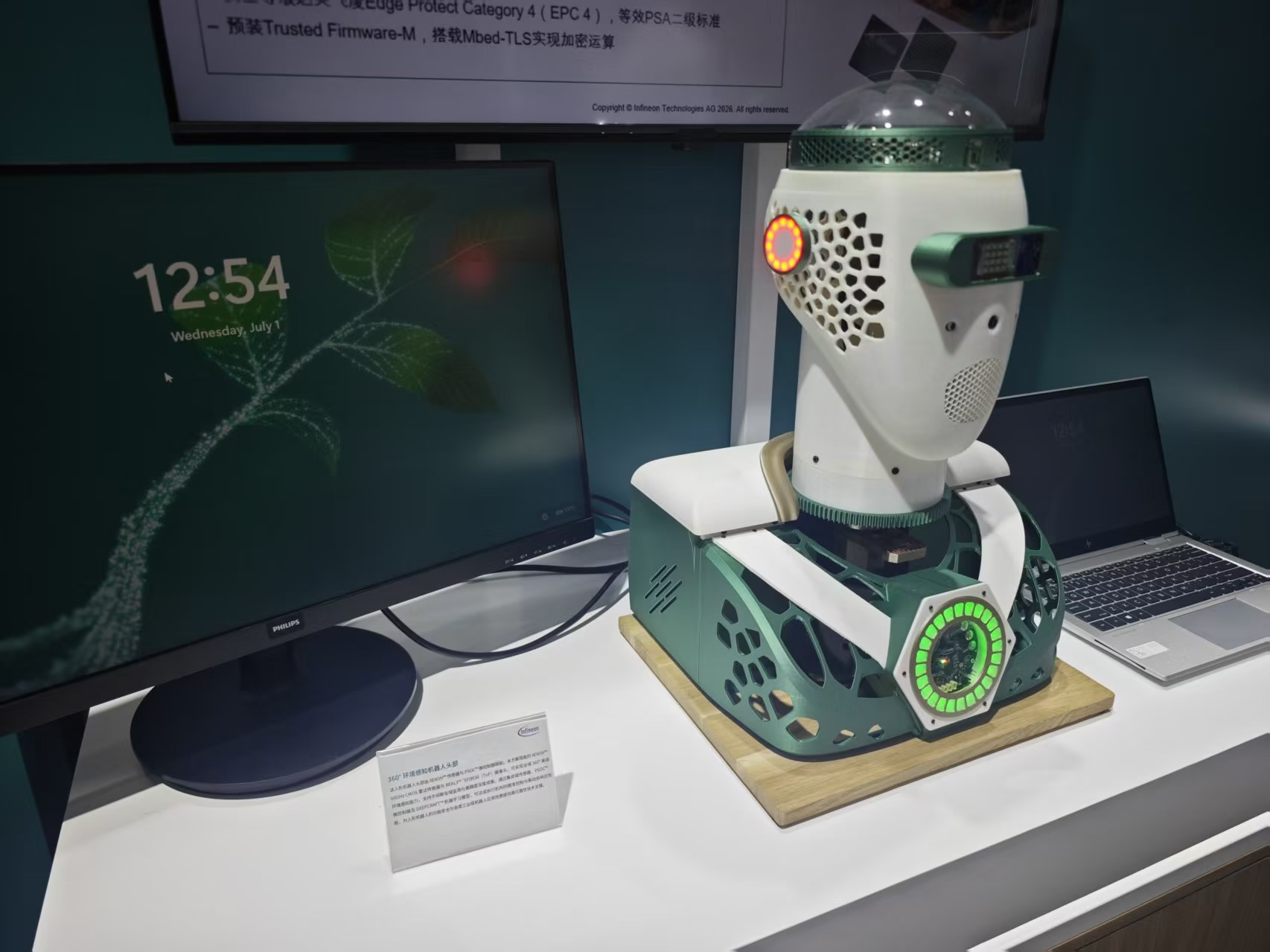
Infineon: TMR + GaN = A Complete Joint-Level Play
Infineon rolled out its full XENSIV TMR magnetic sensor lineup in early June, and the parts were on the bench at the show. The TLI55950 linear TMR sensor caught a lot of attention: 8.1 μTRMS noise floor, 85.5 mV/mT sensitivity, all in a SOT23-6 package. But the real showstopper sat next to it — a coin-sized GaN motor drive module. 34 mm diameter, 5.5 mm thick, 3.3 kW/in³ power density, with integrated TMR current sensing running field-oriented control. That’s a servo drive that fits in your palm.
Infineon’s thesis is clear: TMR for position sensing + GaN for power delivery + AI-based compensation. Three pieces of silicon that together cover the full electronics stack for a humanoid robot joint. It’s a platform play, and it’s well thought out.
Melexis: Inductive Sensing for the Noisy Side of the Motor
Melexis showed their inductive position sensor line, and the pitch is simple: inherent immunity to stray magnetic fields. Their demo featured a cobot joint with the sensor mounted directly next to the stator windings — about as hostile an electromagnetic environment as you’ll find inside a motor housing — and the angular jitter stayed under ±0.1°. For applications where you can’t shield your way out of the problem, inductive is a legitimate alternative to magnetic sensing, and Melexis clearly intends to own that corner of the market.
Allegro and ON Semi: Automotive-Grade Reliability Meets Robotics
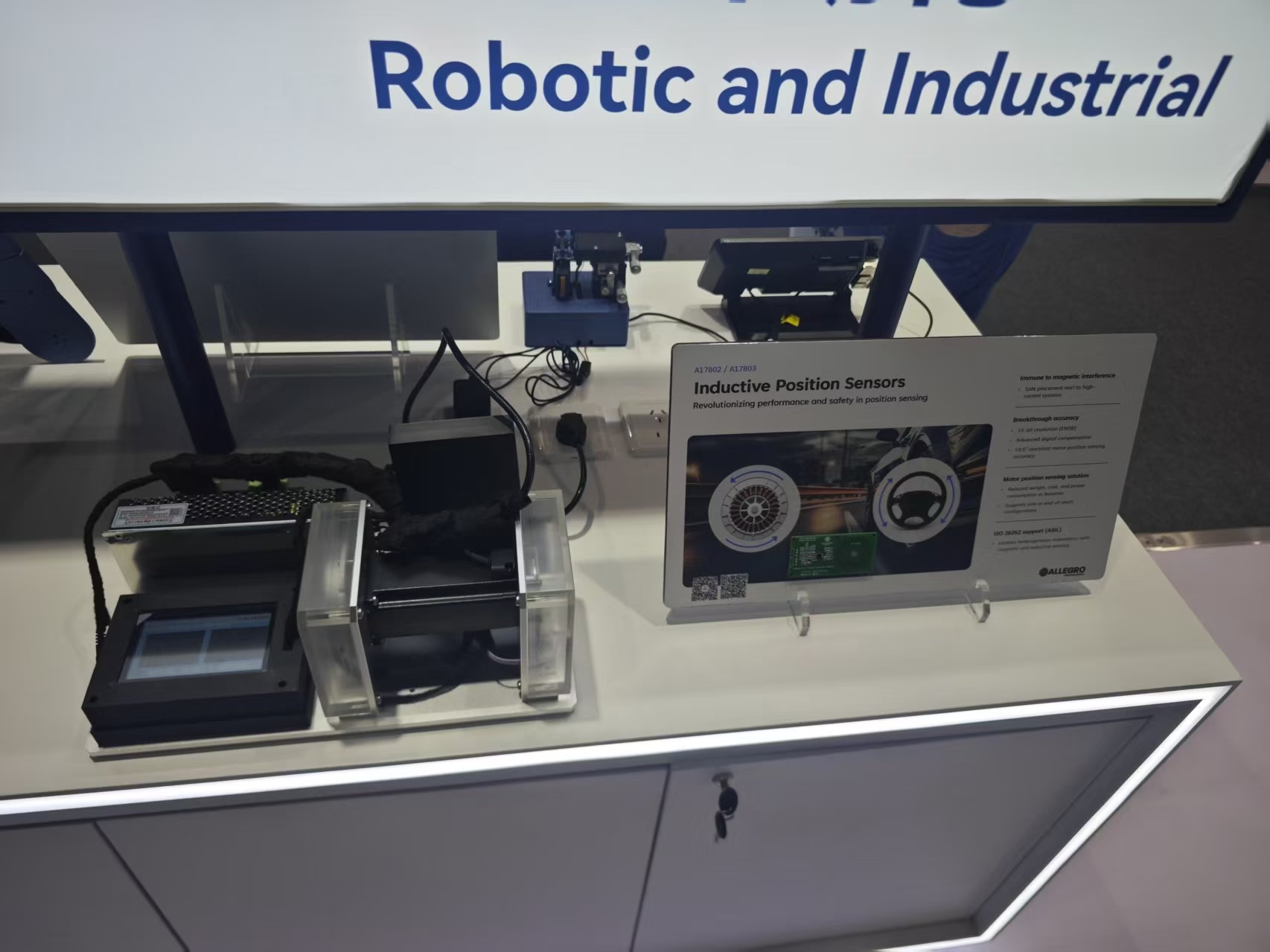
Allegro presented Hall and AMR angle sensors spanning the full -40°C to +160°C automotive temperature range — a reminder that automotive qualification brings reliability margins most robotics startups haven’t even spec’d yet. ON Semi showed a combined current-sensing-plus-position-sensing IC aimed explicitly at BOM reduction and miniaturization for robot joints. Both companies are bringing automotive-grade design discipline to a market that, frankly, needs it.
Chinese Domestic Players: TMR and MCU Innovation on Two Fronts
MultiDimension Technology (MDT): Taking TMR Head-to-Head with the Big Guys
MDT (Booth N3.501) was one of the most crowded domestic booths we saw, and for good reason. They operate their own automotive-qualified TMR wafer fab with an annual capacity in the billions of units — not a design house, an actual manufacturer. Their new TMR3111D magnetic encoder IC deserves a close look:
| Parameter | TMR3111D |
|---|---|
| Max Speed | 40,000 rpm |
| Angular Accuracy | 0.05° |
| Absolute Output | SPI (23-bit internal) |
| Incremental Output | ABZ up to 4,096 PPR |
| Response Time | 2 μs |
| Package | DFN10L (3×3×0.75 mm) |
The part supports both on-axis and off-axis magnet configurations — same chip, two different mechanical layouts. This flexibility matters when you’re designing a robot joint and haven’t locked in whether you’re running a hollow-shaft or end-of-shaft architecture. The booth was packed with joint module engineers working through off-axis ring geometry with the MDT applications team — a conversation that sits squarely in OTV’s wheelhouse.
GigaDevice and MEMSIC: The MCU + Sensor Stack
GigaDevice (Booth N5.205) brought actual hardware: a six-axis robot arm and a quadrupled robot dog (“Steelcoin L1”), both running live on their GD32H75E MCU with integrated encoder interfaces. They’ve onboarded 200+ robotics OEMs for technical对接 and over 100 are already in production. MEMSIC (Booth N3.703) showed AMR magnetic encoders alongside their six-axis IMU portfolio — AMR vs. TMR is shaping up to be the next technology battleground in domestic sensor silicon.
Deep Dive: iC-Haus — The German “Hidden Champion” of Encoder Silicon
In a quiet corner of the magnetic encoder market sits a company that everyone in the field knows, even if their booth doesn’t dominate the hall: iC-Haus. Based in Germany, they’ve built what is arguably the most widely adopted off-axis encoder IC platform in the industry. Their product line spans both off-axis and on-axis topologies — the two architectures that together cover virtually every robot joint feedback scenario.
iC-MU Series: The Off-Axis Standard
The iC-MU family is, by any honest measure, the most broadly deployed off-axis absolute encoder IC platform in industrial robotics. Three variants cover the full pole-width spectrum:
| Variant | Pole Width | Max Absolute Resolution | Typical Application |
|---|---|---|---|
| iC-MU | 1.28 mm | 18-bit (16/15) | Compact joints, miniature encoders |
| iC-MU150 | 1.50 mm | 19-bit (32/31) | Collaborative robots, servo motors |
| iC-MU200 | 2.00 mm | 20-bit (64/63) | Large-diameter rings, industrial robots |
The underlying principle is Nonius (Vernier) dual-track encoding: two concentric magnetic tracks with different pole-pair counts (e.g., 64 vs. 63) create a unique phase relationship across the full 360° revolution. That phase difference encodes absolute angular position without batteries, without homing routines, and without optical components that don’t survive the factory floor.
Critically for robot joint design, the iC-MU’s off-axis architecture places the sensor IC beside the magnetic ring rather than above the shaft center. The entire bore stays clear for cabling, fluid lines, or structural elements — a hard requirement for hollow-shaft harmonic drive joints that no on-axis solution can meet.
iC-TW39: 24-Bit TMR On-Axis Sensing
If the iC-MU defined off-axis encoding, iC-Haus’s new iC-TW39 raises the bar for on-axis (end-of-shaft) applications. This is a TMR-based SoC angle sensor that delivers performance numbers worth paying attention to:
| Parameter | iC-TW39 |
|---|---|
| Sensing Technology | TMR (Tunnel Magnetoresistance) |
| Resolution | 24-bit |
| Accuracy | ±0.15° INL |
| Latency | ~1.5 μs |
| Output Interfaces | BiSS C / SSI / SPI / ABZ / UVW |
| Operating Temp | -40°C to +115°C |
| Multiturn Support | Yes (external battery-backed sensor) |
The shift from Hall to TMR is the key story here. TMR delivers significantly higher magnetic sensitivity than conventional Hall elements, which translates directly into larger allowable air gaps, wider mechanical tolerances, and better SNR at speed. For a robot joint where every micron of stack height counts and thermal expansion is inevitable, those tolerances aren’t nice-to-haves — they’re the difference between shipping and re-spinning the mechanical design.
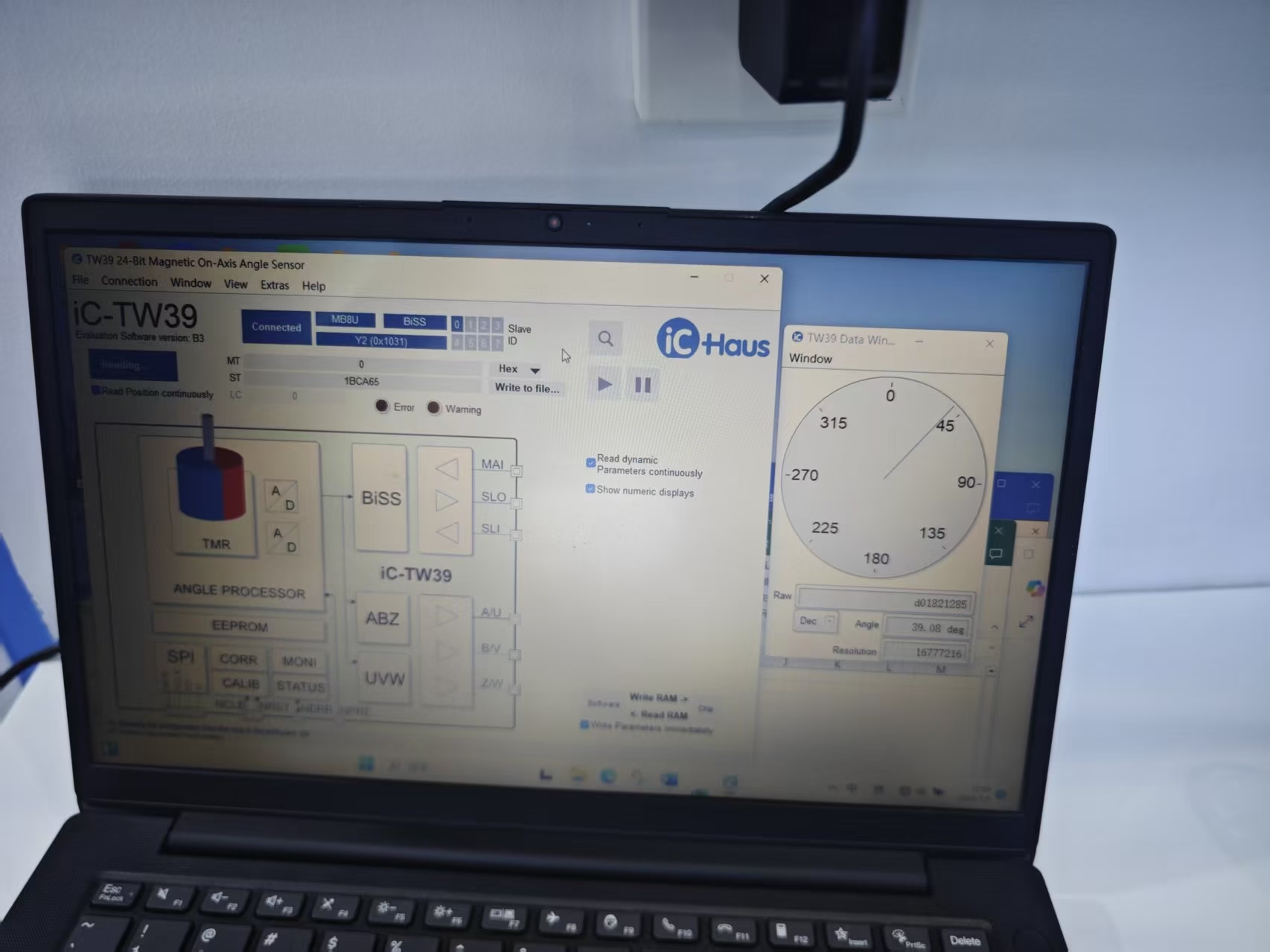
iC-MU for off-axis, iC-TW39 for on-axis — between these two product lines, iC-Haus covers the full mechanical topology spectrum for robot joint position feedback. If you’re designing a humanoid, a cobot, or a surgical robot, you’re almost certainly evaluating one or both of these chips.
Also Worth Noting
- iC-MUE: Next-generation off-axis absolute encoder SoC with differential sensing and wider mechanical tolerances
- iC-RT2624: 26-bit optical absolute encoder SoC, angle accuracy better than 0.01° — for applications where magnetic isn’t enough
- iC-MBE: Compact BiSS/SSI master controller with integrated diagnostics
OTV Sensing Take: The Magnetic Ring — Where chip Precision Meets the Physical World
If electronica China 2026 made one thing clear, it’s this: magnetic encoder ICs are transitioning from a niche industrial component into core infrastructure for embodied AI. When Infineon, Melexis, Allegro, iC-Haus, MDT, MEMSIC, and GigaDevice are all placing heavy bets on the same technology vector, the demand signal is no longer speculative.
But the silicon is only half the story. The magnetic ring is the physical interface that translates the chip’s design precision into real-world angular data. A 24-bit interpolator or a ±0.15° INL spec on a datasheet only materializes if the magnetic target delivers the field geometry the chip was designed to read.
Think of it as a signal chain: the encoder IC is the processor, and the magnetic ring is the sensor front-end. Both need to perform at the same level. Four ring parameters are critical to closing that loop:
- Pole width precision: The iC-MU family expects pole widths matched to 1.28, 1.50, or 2.00 mm. Holding pole width within 5% of nominal keeps interpolation error where the chip’s internal calibration expects it to be.
- Magnetic field uniformity: Nonius encoding depends on a consistent amplitude ratio between the master and nonius tracks. Uniform field strength across the ring circumference directly correlates with low angular noise in the final output.
- Thermal stability: A robot joint can swing 80°C or more from cold start to full load. Matching the ring material’s remanence temperature coefficient to the application’s thermal profile ensures the chip’s AGC stays within its linear range across the full operating envelope.
- Air gap optimization: The iC-MU series requires chip-surface field strength between 15 and 100 kA/m. Proper air gap design — typically around 0.4 mm — keeps the field in the sweet spot where SNR is high and the AGC isn’t working at its limits.
OTV Sensing manufactures precision magnetic encoder rings across the full material spectrum — NBR rubber-bonded ferrite, sintered ferrite, bonded NdFeB, sintered NdFeB (including high-coercivity grades), and SmCo — with pole width accuracy, field uniformity, and thermal stability engineered to match the requirements of iC-Haus, Infineon, Melexis, MDT, and other leading encoder IC platforms. Standard samples ship in two weeks. Mass production in four.
Need Precision Magnetic Rings for Your Encoder Platform?
Whether you’re designing around iC-Haus iC-MU/TW39, Infineon TMR, MDT, or any other encoder IC — we deliver custom magnetic rings with precise pole widths, optimized materials, and consistent quality at production scale. Samples in 2 weeks.
Request Your Custom Magnetic Ring Quote →
electronica China 2026: July 1–3, Shanghai New International Expo Centre. References: iC-Haus product documentation, Infineon XENSIV product line, MDT official press release, GigaDevice official news.