
Absolute Inductive Encoder
I. Introduction to Inductive Sensing
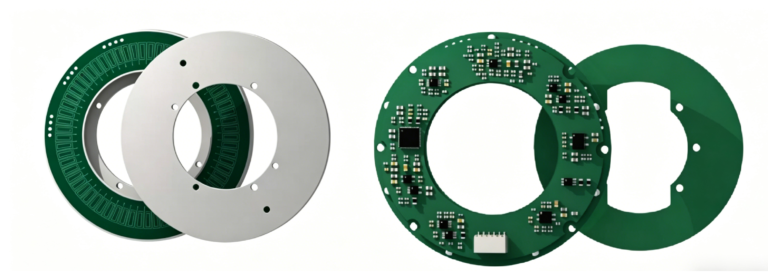
Traditional optical encoders, while precise, often struggle in environments with high vibration, dust, or oil due to their fragile glass discs and sensitive light paths.
Our inductive encoders are designed as high-precision, compact design, non-contact for motion control applications. Utilizing advanced non-contact electromagnetic induction and wireless energy transfer technology, it eliminates the need for internal bearings, optical discs, or light sources.
With resolutions up to 20 bits and support for multiple protocols like BiSS-C and SSI, TVO inductive encoder delivers robust, maintenance-free performance even in harsh conditions
2. Operating Principle: Wireless Energy Transfer
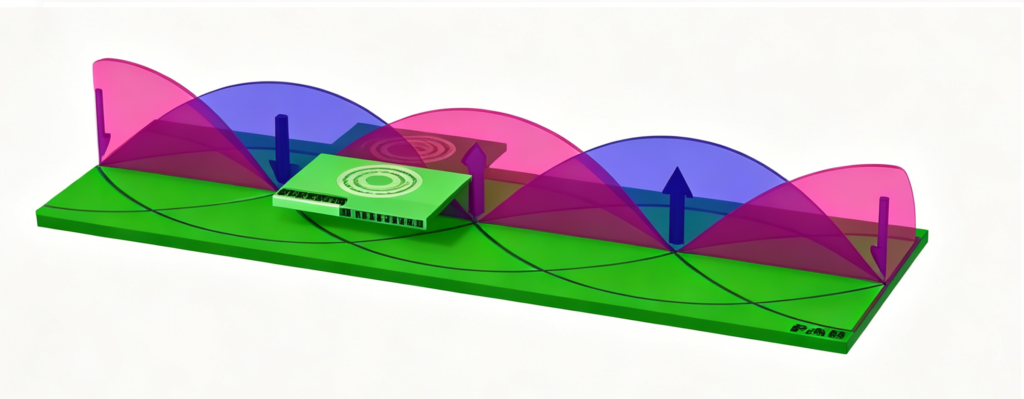
- Stator Function: The stator is the active component. Once powered, it wirelessly transmits energy to the rotor.
- Rotor Response: The rotor, which requires no external power supply or battery, receives this energy and applies it to its internal coils to generate a regular electromagnetic field.
- Signal Resolution: The stator then senses this electromagnetic field. Utilizing a dual-code track design, the encoder calculates the absolute angular position in real-time.
3. OTV-INE Series Inductive Encoder: Key Features and Technical Advantages
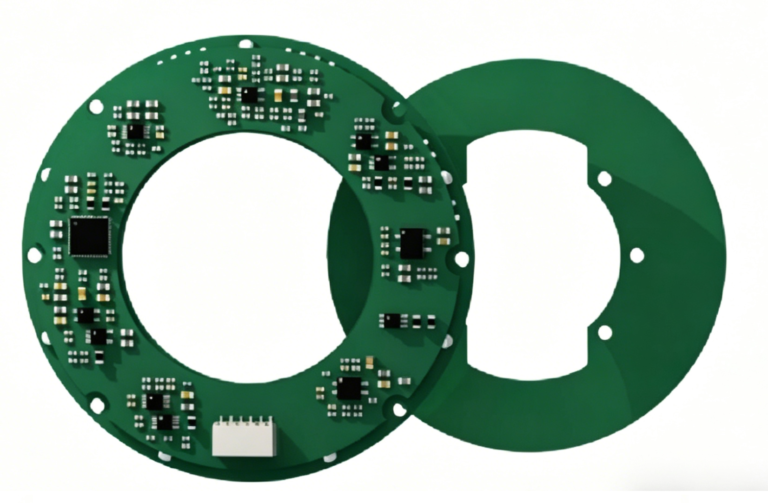
- Compact Hollow-Shaft Structure: Both the stator and rotor feature a ring-shaped, thin-film hollow structure. The large 35mm center opening is ideal for passing through mechanical shafts, cables, or other structural components.
- Bearingless & Coupling-Free: The encoder does not include integrated bearings. It requires no mechanical coupling during installation, which simplifies the assembly process and reduces the overall system footprint.
- Environmental Resilience: Because it lacks ball bearings, glass discs, and light sources, the OTV-80 is naturally resistant to vibration, shock, and magnetic interference. It operates reliably within a temperature range of -30°C to +100°C.
- High Precision: Despite its ruggedness, it offers a resolution of 18 to 20 bits, a maximum static error of only ±0.008°, and a repetition error of ±2 LSB
4. Comprehensive Electrical Interface and Protocols
- Performance: Supports clock frequencies from 0.5MHz to 5.0MHz.
- Mechanism: Data is shifted out on the rising edge of the clock generated by the master device, starting with the Most Significant Bit (MSB).
- Best Use Case: Ideal for medium-speed, high-precision industrial automation and medical devices where cost-effectiveness and standardization are priorities.
- Timing: The encoder locks data on the rising edge and updates the output on the falling edge.
- Data Integrity: Includes a 6-bit CRC (polynomial: x6+x1+x0) for error and warning detection.
- Multi-turn Support: Multi-turn data is embedded directly in the position bits, simplifying angle resolution for the user.
- Transmission: Data is automatically transmitted to the host at a fixed update rate of 2000Hz and a baud rate of 460800bps.
- Advantage: Supports long-distance transmission (up to several hundred meters) and is highly resistant to EMI.
- Commands: Supports specific requests for single-turn data, encoder ID, and error status (EA0/EA1 for counting/temperature errors).
- Speed: Operates at a high baud rate of 2.5Mbps.
- Z-Phase: Outputs a single zero-pulse per revolution for mechanical zero-point calibration.
- Advantage: Low-cost hardware decoding and high-speed response for real-time rotation detection
5. OTV-INE Series Inductive Encoder Product List
Model Number | Dimensions (OD/ID/Thickness) | Weight | Resolution | Accuracy | Max Speed | Rotor Inertia |
|---|---|---|---|---|---|---|
OTV-INE-014 | 14.8 / 2 / 3.6 mm | 2 g | 15-17 bit | ±0.03° | 6000 rpm | 0.006 kg·mm² |
OTV-INE-016 | 16.8 / 2 / 3.6 mm | 2.5 g | 15-17 bit | ±0.025° | 6000 rpm | 0.008 kg·mm² |
OTV-INE-018 | 18.8 / 2 / 3.6 mm | 3 g | 15-17 bit | ±0.02° | 6000 rpm | 0.01 kg·mm² |
OTV-INE-020 | 20 / 4 / 6.5 mm | 4 g | 15-17 bit | ±0.05° | 4000 rpm | 0.01 kg·mm² |
OTV-INE-040 | 40 / 10 / 7.8 mm | 10 g | 17-18 bit | ±0.015° | 6000 rpm | 0.4 kg·mm² |
OTV-INE-052 | 52 / 17.7 / 7.6 mm | 13 g | 18-20 bit | ±0.01° | 8000 rpm | 1.18 kg·mm² |
OTV-INE-060 | 60 / 25 / 7.6 mm | 18 g | 18-20 bit | ±0.008°~±0.01° | 8000 rpm | 2.43 kg·mm² |
OTV-INE-080 | 80 / 35 / 8 mm | 30 g | 18-20 bit | ±0.008°~±0.01° | 8000 rpm | 8.6 kg·mm² |
OTV-INE-100 | 100 / 48 / 8 mm | 40 g | 19-21 bit | ±0.006°~±0.01° | 6000 rpm | 19.7 kg·mm² |
OTV-INE-120 | 120 / 70 / 8 mm | 50 g | 19-21 bit | ±0.006°~±0.01° | 6000 rpm | 40 kg·mm² |
OTV-INE-140 | 140 / 90 / 8 mm | 75 g | 19-21 bit | ±0.006°~±0.01° | 6000 rpm | 99 kg·mm² |
OTV-INE-180 | 180 / 120 / 8 mm | 120 g | 20-22 bit | ±0.006°~±0.01° | 4000 rpm | 239.2 kg·mm² |
OTV-INE-247 | 247 / 172 / 8 mm | 180 g | 20-22 bit | ±0.006°~±0.01° | 4000 rpm | 795.6 kg·mm² |
- Supply Voltage: 5 – 24V DC
- Output Protocols: SSi, BiSS-C, RS-422, RS-485, Differential ABZ
- Operating Temperature: -30°C to +100°C
- Maximum Protection Grade: IP40
- Materials: Stator and rotor are made of FR-4 flame-resistant material.
- Standard Features: Non-contact, hollow-shaft, high precision, low power consumption, and maintenance-free
6.Key Industry Applications
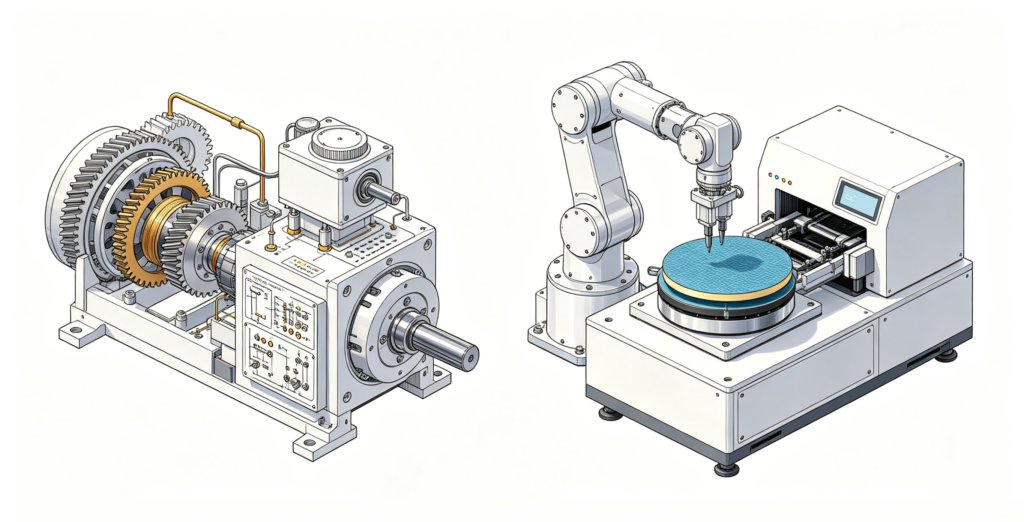
- Collaborative Robots & Robot Joints
- Surgical Robots & Medical Equipment
- Aerospace & Defense Systems (Satellite dishes, radar)
- Industrial Automation (AGVs, semiconductor handling)
- Optical Platforms & Laser Scanners
Our OTV-INE series provides a robust and comprehensive range of standard high-precision inductive encoders. In the meantime,we could offer fully customized product solutions according to your specific mechanical, environmental challenges, and performance requirements.
Thanks to contact us for better understanding.
FAQ
1.What is the main advantage of an inductive encoder over an optical one?
Unlike optical encoders, the OTV-INE has no glass disc or light source. This makes it immune to failures caused by dust, oil, or vibrations, and it requires no internal bearings, making it thinner and more durable.
2.What is the main advantage of an inductive encoder over an magnetic one?
The inductive encoder could offer higher accuracy up to ±0.008° compare to magnetic encoder. If considering high quantity, cost of inductive encoder could be more competitive,roughly speaking.
3.What is the standard MOQ for your OTV-INE inductive encoder?
We are flexible to discuss volume-based adjustments for testing or trial orders.
4.How critical is the installation gap between the stator and rotor?
The gap is important for optimal energy transfer and signal sensing. The recommended gap is 0.6mm, with an allowable tolerance of ±0.1mm.
5.Does the encoder retain its position after a power loss?
Yes, the OTV-INE provides absolute position output (single-turn), meaning it knows its exact angle immediately upon power-up without needing to return to a home position
6.Can I customize the cable length or orientation?
Yes, OTV Sensing offers different exit forms, including side-exit cables (standard 250mm) and side-mount connectors.