
Maxwell: Translating God’s Language with Mathematics
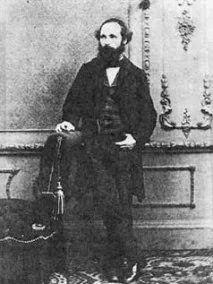
“Maxwell’s work is the most profound and the most fruitful that physics has experienced since the time of Newton.”
— Albert Einstein
If Newton translated the language of “force,” Maxwell translated the language of “fields.” Electricity and magnetism, light and waves, energy and spacetime — under his pen, they became different entries in the same dictionary.
He didn’t run experiments. He used mathematical reasoning and physical intuition — read Faraday’s lab reports, sat down at his desk, picked up his pen, and began to “translate.”
1. Before Maxwell, Electricity and Magnetism Were Two Worlds
By Maxwell’s time, electromagnetism had accumulated over eighty years of discovery — but the pieces were scattered, like dictionary entries without an index.
The force between two stationary charges follows the inverse-square law. Describes only electrostatics.
F = k · q₁q₂ / r²
Accidentally discovered during a classroom demonstration that a current-carrying wire deflects a nearby compass needle. Humanity’s first glimpse of a link between electricity and magnetism. A phenomenon without a precise equation.
An electric current produces a circulating magnetic field. Right-hand rule: thumb in current direction, curled fingers show the field. But valid only for steady (constant) currents.
∮B·dl = μ₀I
The inverse of Ampère’s law: a changing magnetic field induces a voltage in a wire loop. The foundation of generators, transformers, wireless charging, and inductive encoders. Faraday lacked mathematical training — he needed someone to write the equations.
ε = -dΦ/dt
The minus sign is Lenz’s law: the induced current always opposes the change in flux
Four men. Four discoveries. Intimately related, yet no one had stitched them into a single book. Worse still, Ampère’s law broke down inside a capacitor — a magnetic field clearly existed between the plates, yet no current flowed through. The theory had a mathematical hole.
2. He Picked Up His Pen and Began to “Translate”
Maxwell’s approach was unique: find the direction with physical intuition, then deliver the proof with mathematical rigor. Faraday’s “lines of force” became, under Maxwell’s pen, vector field equations.
The core problem: how to patch the hole in Ampère’s law?
Between the plates of a capacitor — no wires, no moving charges — but a changing electric field does exist. Maxwell made a bold hypothesis: this changing electric field itself generates a magnetic field, equivalent to a kind of “current.” He called it the “displacement current.” There was zero experimental evidence for this idea — it came purely from his belief in symmetry.
Ampère’s original law (valid only where conduction current exists)
∇×B = μ₀J
Maxwell adds the displacement current — the equation becomes complete
∇×B = μ₀J + μ₀ε₀·∂E/∂t
The added term — pure physical intuition, demanded by no experiment
3. The Magic of Mathematics: From Four Equations to One Prediction
Maxwell placed his corrected Ampère’s law alongside the other three, producing a complete set. Then he did something no one had thought to do — solve the equations in empty space, with no charges and no currents.
Step 1 — The equations in vacuum (set ρ = 0, J = 0)
∇×E = -∂B/∂t ∇×B = μ₀ε₀·∂E/∂t
Step 2 — Take the curl of Faraday’s law
Expand with vector identity: ∇×(∇×E) = ∇(∇·E) – ∇²E
Step 3 — Substitute ∇·E = 0 and the 4th equation for ∂B/∂t
∇²E = μ₀ε₀ · ∂²E/∂t²
The same steps applied to B yield an identical equation
Step 4 — Recognize the wave equation
Standard wave equation: ∇²f = (1/v²) · ∂²f/∂t²
Maxwell’s result: ∇²E = μ₀ε₀ · ∂²E/∂t²
Therefore: v = 1/√(μ₀ε₀)
Plugging in known values of μ₀ and ε₀ → v ≈ 3.1×10⁸ m/s
The Historic Moment
1849, Fizeau measures the speed of light: 3.15×10⁸ m/s
1850, Foucault measures the speed of light: 2.98×10⁸ m/s
Maxwell’s calculated electromagnetic wave speed: 3.1×10⁸ m/s
He put down his pen and wrote the most astonishing sentence in physics history:
“Light itself — including thermal and other radiation — is an electromagnetic disturbance propagated as a wave.”
He ran no experiment. He had never seen an electromagnetic wave. Yet with pure mathematical deduction, he proved that light IS an electromagnetic wave. This was the first time in human history that a person, armed only with pen and paper, discovered an entirely new natural phenomenon.
3.1 A Deeper Implication: Why the Speed of Light Is the Ultimate Limit
Maxwell’s result showed that the speed of electromagnetic waves depends only on two universal constants — the permeability μ₀ and permittivity ε₀ of free space. They describe properties of space itself. This means the speed of light does not depend on the motion of its source.
This contradicts everyday intuition — throw a ball forward on a moving train, and its speed = train speed + throw speed. But Maxwell’s equations say: light doesn’t work that way. No matter how fast you chase a beam of light, it always moves away from you at exactly c.
In 1887, the Michelson-Morley experiment proved light speed is indeed invariant. In 1905, Einstein took “constancy of the speed of light” as his starting point and built special relativity. The conclusion: c is not a property of light — it is the ultimate speed limit of spacetime itself.
4. Four Equations, One Cosmic Dictionary
The Maxwell equations we see today were organized into vector form by Oliver Heaviside in 1884. They are among the most concise, symmetric, and information-rich formulas in all of physics:
MAXWELL’S EQUATIONS — Heaviside Vector Form
∇·E = ρ / ε₀
Gauss’s Law: Electric charges are sources of the electric field.
∇·B = 0
Gauss’s Law for Magnetism: Magnetic field lines have no beginning or end — no magnetic monopoles exist.
∇×E = -∂B / ∂t
Faraday’s Law: A changing magnetic field produces a circulating electric field.
∇×B = μ₀J + μ₀ε₀ ∂E/∂t
Ampère-Maxwell Law: Both currents and changing electric fields produce magnetic fields.
The orange term = Maxwell’s displacement current — pure mathematical intuition
4.1 The Lorentz Force: The “Hidden Fifth Member”
Maxwell’s equations describe how fields are generated — but a crucial question remains: how do fields act on charges? The answer lies in the Lorentz force law.
Lorentz Force (1895, Hendrik Lorentz)
F = qE + qv × B
Electric force (independent of velocity) + Magnetic force (perpendicular to velocity)
qE: The electrostatic force — acts on any charge along electric field lines. Coulomb’s law in another form.
qv×B: The magnetic force — acts only on moving charges, perpendicular to both velocity and field. Electric motors, mass spectrometers, and Hall sensors all depend on this term.
5. He Never Thought Within a Single Discipline
Maxwell’s most underrated gift was his ability to build bridges between different fields of knowledge. He never confined himself to electromagnetism — his mind moved freely across disciplines, leaving marks at every intersection.
Proved mathematically that Saturn’s rings must consist of countless independent particles. Confirmed 120 years later by the Voyager spacecraft.
Proved the human eye perceives all colors through just red, green, and blue — then produced the world’s first color photograph. The RGB principle underpins all color displays today.
Derived the Maxwell distribution of molecular velocities, founding statistical mechanics. He brought probability theory into physics.
A thought experiment about a “demon” sorting molecules — it troubled physicists for nearly a century and ultimately inspired Shannon to create information theory.
Appointed the first director. Designed the laboratory, procured instruments, established systems. Under his foundation, it produced 29 Nobel laureates.
6. Everything He Predicted Later Came True
Maxwell died in 1879 at age 48. That same year, Einstein was born in Germany. He didn’t live to see his predictions confirmed.
First to generate and detect EM waves in a laboratory. He said: “It’s of no use whatsoever.” — He had no idea he’d just invented radio.
EM waves crossed the Atlantic. From Maxwell’s paper to a world-changing technology took just 30 years.
Directly benefited from Maxwell’s hint that the speed of light is invariant. The Lorentz transformation was derived from EM wave behavior.
WiFi, 5G, microwave ovens, radar, MRI, radio telescopes, wireless charging, inductive encoders — all run on the EM waves Maxwell predicted from nothing but equations.
7. Translating God’s Language with Mathematics
What Maxwell left us isn’t just four equations. It’s a way of thinking:
① Physical intuition + mathematical rigor. Faraday’s “lines of force” gave direction; partial differential equations gave precision. Both are indispensable.
② Cross-disciplinary thinking. Mechanics, thermodynamics, electromagnetism, astronomy, physiology — he moved freely among them and discovered connections at every intersection.
③ Trust the predictive power of mathematics. The displacement current had no experimental support. Electromagnetic waves had never been seen. But he trusted the symmetry of the equations. He was right.
④ Pursue unity. He was never satisfied with electricity and magnetism as separate laws. He intuitively believed they were two sides of the same coin. This belief in unification became the driving force of all subsequent physics.
8. From “Dafty” to Giant: The Making of Maxwell
Einstein kept three photographs on his desk — Newton, Faraday, and Maxwell. To be so revered by Einstein, Maxwell’s life story deserves to be remembered.
Born in Scotland. His mother died of stomach cancer when he was eight — the same disease that would take his life at nearly the same age.
Wore strange homemade clothes, spoke with a thick rural accent, mocked by classmates with the nickname “Dafty” (fool). Yet wandering the countryside — observing streams, building models — shaped his unique method: feel with intuition first, prove with mathematics later.
Discovered a new method for drawing oval curves. The paper was accepted by the Royal Society of Edinburgh. A 14-year-old’s mathematical discovery, published by the Royal Society.
Graduated as “Second Wrangler” (second place in the Mathematical Tripos). His room overflowed with electromagnetic coils and scattered notes. His tutor said: “This student can see physics through mathematics.”
Aberdeen → King’s College London → resigned and retreated to his family estate, Glenlair. In the silence of the countryside, he completed “A Treatise on Electricity and Magnetism” — one of the most important works in the history of physics.
Designed the laboratory personally and established its systems. It went on to produce 29 Nobel laureates.
Died November 5, 1879 of stomach cancer. His last words: “I have been thinking about those matters of electricity and magnetism.”
That year, Einstein was born in Germany. As if the universe arranged for one to leave and another to arrive.
“His great works were not produced in a frantic race — but in the quiet of the countryside, in the deepest contemplation of nature, stroke by stroke.”
— In tribute to James Clerk Maxwell (1831–1879)
From Maxwell’s Equations to Your Encoder
OTV Precision Sensing specializes in precision inductive and magnetic encoders. Faraday’s electromagnetic induction and Ampère’s magnetic field principles run inside every encoder we build — from standard products to fully customized sensing solutions.
Whether you need a standard encoder or a custom sensing solution, we welcome the conversation.
OTV Precision Sensing | www.otvsensing.com